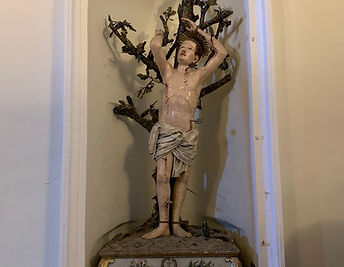
Saint Rocco

Saint Rocco is the patron saint of Petacciato. Born in Montpellier between 1345 and 1350, he died in Voghera between 1376 and 1379. Prayer and charity were his strength. In those years, the plague was devastating entire cities, and Rocco, wherever he stopped, provided assistance: he traced the sign of the cross on the sick, healing them, and invoked the Trinity for the healing of the plague victims. He became God's instrument for performing miraculous healings. When he contracted the plague, he stopped on the banks of the Po, far from everyone. There, he was found by a dog that saved him from starvation by bringing him a crust of bread every day. His wealthy owner, a certain Gottardo, followed him and discovered the Saint's refuge. Rocco was cured by him, receiving in return the greatest gift: faith and charity. Saint Rocco was the pilgrim par excellence, with his typical attire: a wide hat to protect from rain and sun, a cape reaching to his knees, a staff—a long staff with a gourd for water—a rosary tied to his belt, and a seashell around his neck, useful for drawing water. The Council of Constance in 1414 invoked him as a saint for deliverance from the plague that had spread there during the council's deliberations. After the cholera epidemic that struck Petacciato in 1837, its church was dedicated to Saint Rocco. Today, the new church, which now bears the name of Saint Rocco, houses a beautiful papier-mâché statue created by the Falcucci masters of Atessa, who specialized in the creation of processional sculptures. The statue was most likely commissioned by the Dukes of Avalos.
Saint Nicholas

The second weekend of May marks a very important anniversary for the
Petacciato, the festival in honor of Saint Nicholas. The festivities begin on Saturday.
afternoon with the traditional mass in the rural chapel dedicated to the Saint, located in
Contrada Marozza, at the end of which follows the procession to accompany San
Nicholas to the village, to the Triumph set up by devotees in Independence Square. It's tradition
Keeping vigil in prayer all night long, the Saint. In the evening, there's also a musical performance and fireworks! On Sunday morning, an open-air Mass is celebrated at the Trionfo, followed by a solemn procession where songs are sung in honor of Saint Nicholas.
Saint Anthony the Abbot
Every year, on the evening of January 16th, Petacciato is reborn with ancient traditions with the evocative
A popular representation of Saint Anthony the Abbot. Two groups of "hermits," dressed in robes.
dark and cloaked, they animate the streets of the town and private houses, giving life to choirs and songs
traditionally known as “Lu Sant'Antonj”. In the story, Saint Anthony is tempted by the devil
and helped by angels, while the audience watches involved in dance steps, narration and
popular music. It is a centuries-old rite, which renews collective devotion and the
competitive hospitality of the families, who secretly negotiate the stages of the procession for
To ensure the best possible welcome for hermits. It was a peculiar custom to place images of the saint in stables to protect animals and people.

Courtesy of the Sant'Antonio Boys Association
Saint Anthony of Padua

Alongside the January festival, Petacciato celebrates Saint Anthony of Padua in September with a lively village festival. Traditionally, on September 10th, a procession carrying the saint's effigy sets out from the Church of San Rocco, followed by community events along Viale Pietravalle: musical performances, food stalls, and entertainment for all ages. In addition to the traditional parade of decorated ox-drawn floats, fireworks light up the atmosphere as night falls, capping off an evening of faith, folklore, and fun organized by the local festival committee.
Saint Sebastian
The representation of San Sebastiano which takes place in the month of January is a moment
very important, heartfelt and characteristic for the community of Petacciato. Walking through the streets of the town it will be possible to come across the folk group singing songs and
wearing traditional clothes tells the life of the Saint. According to tradition, Sebastian,
Roman soldier, he was arrested and sentenced to be shot with arrows by the Emperor Diocletian, because he supported Christianity.